Neeraj Bansal first Generation Entrepreneur-Engineering Comfort
Neeraj Bansal is a First Generation entrepreneur who transformed a vision into one of India's leading motion furniture manufacturing companies. Through innovation, quality craftsmanship, and customer-centric thinking, he has redefined comfort while building a globally recognized brand. His journey reflects resilience, purpose, and the spirit of Indian manufacturing excellence

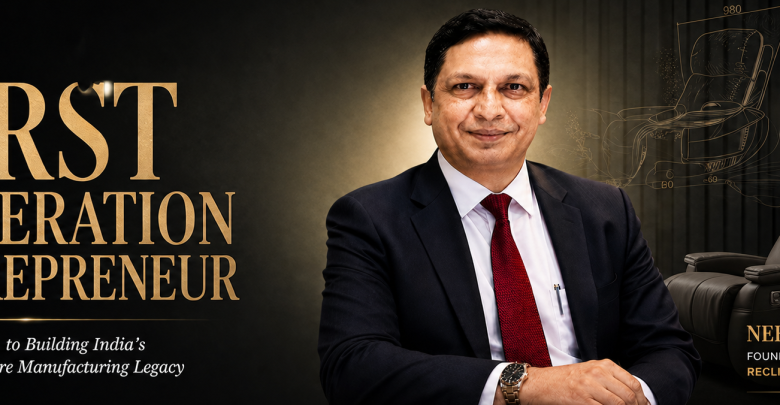
First generation entrepreneur, CEO of Recliners India, representing the spirit of entrepreneurship and dedication in business.
There’s a particular kind of comfort that most of us take for granted, the moment you sink into a recliner after a brutal day, and your body just… exhales. Somewhere behind that small, quiet relief is a man who has spent nearly three decades turning a simple idea into one of India’s most recognized names in motion furniture. His name is Neeraj Bansal, and he is the Founder and CEO of Recliners India.
This isn’t a rags-to-riches story dressed up in dramatic flourishes. It’s something more relatable, the story of a first-generation entrepreneur who left the predictability of a paycheck for the uncertainty of building something of his own, with no family business or inherited playbook to fall back on, and then stuck with it long enough to watch it become an industry leader.
A Foundation Built on Global Standards
Before recliners, before the factory floors, before “Shri Neeraj Bansal” became a name associated with luxury seating in India, he built his early career at two very different, highly respected organizations IBM and Zwilling J.A. Henckels. One a global technology giant, the other a centuries-old name in precision manufacturing and design.
That combination shaped how he thinks about business. Tech-driven discipline on one side. Old-world craftsmanship and manufacturing rigor on the other. Look closely at how Recliners India operates today heavy on R&D, obsessive about engineering, but still deeply rooted in comfort and craftsmanship and you can see traces of both worlds in it. It’s rarely a straight line from someone’s early career to their life’s work, but with Bansal, the dots connect in a way that feels almost intentional in hindsight.
The Philosophy: Depth Over Noise
Ask most founders what drives them and you’ll get some version of “disruption” or “scale.” Bansal’s approach reads differently. His leadership philosophy is built on staying in one lane and going deeper into it than almost anyone else is willing to choosing mastery of a single category over the temptation to chase every adjacent opportunity.
That’s a harder discipline than it sounds. It means saying no to easy expansion. It means being comfortable being known for one thing, extremely well done, in a market that constantly rewards the loud and the fast. Bansal has built a reputation instead on the quieter currency of consistency showing up in the same industry, solving the same core problem, for nearly three decades.
Building Without a Blueprint
There’s a particular kind of resolve that comes with being a first-generation entrepreneur. No legacy business to step into, no established network of suppliers or buyers handed down, no built-in credibility that comes with a family name already known in the industry. Every relationship, every early customer, every ounce of trust the business earned had to be built from scratch.
That reality shapes a leader differently. It tends to produce founders who are more hands-on, more risk-aware, and far more attached to the fundamentals of the business than those who inherit a running engine. Bansal’s leadership carries that imprint — a founder-led intensity that comes from having built every layer of the business himself, rather than optimizing something that was already there.
Leading From the Front, Not From a Podium
What’s striking about Bansal as a leader is how little distance he keeps from the actual work. He’s represented Indian manufacturing on national platforms like Vibrant Gujarat and Vibrant Kutch — forums where policy, industry, and investment intersect — but he’s just as present in the day-to-day decisions that shape product quality and customer experience. That’s a rare combination: a leader equally comfortable in a boardroom or a policy summit as he is close to the factory floor.
It points to a broader vision — that leadership isn’t a title you hold above a business, it’s a posture you take inside it. Bansal’s version of being CEO looks less like managing from a distance and more like staying genuinely close to the craft.
A Vision Rooted in a Human Need
At the center of Bansal’s thinking is a simple but powerful belief: comfort isn’t a luxury — it’s something people quietly need after long, demanding days, and it deserves to be engineered with the same seriousness as any high-performance product. That belief has shaped everything from R&D priorities to how the business defines success.
It’s a vision built less around chasing markets and more around solving something deeply human. And that’s often what separates founders who build companies from founders who build categories.
Why This Kind of Leadership Matters
In an era obsessed with overnight scale and headline-grabbing announcements, there’s something quietly powerful about a leader whose philosophy is built on patience, focus, and staying close to the work. Neeraj Bansal’s leadership style isn’t loud. It doesn’t chase trend cycles or reinvent itself every quarter.
It’s the kind of leadership defined by long-term conviction — a belief that if you understand a human need well enough and commit to solving it properly, the results follow. That’s not a flashy philosophy. But it’s the kind that builds something meant to last.
This piece is based on publicly available professional information about Neeraj Bansal and Recliners India.