A wave of student suicides, a bloodied march on Parliament, and a government that still hasn’t sent its education minister to the table, here’s everything happening at Jantar Mantar, and why it matters.
Somewhere in Sikar right now, a coaching-hub town that has sent thousands of Rajasthan’s children chasing a single dream, a room sits locked that used to belong to a 22-year-old named Umesh Mali. He left behind a note. He is one of at least 11, and by some counts as many as 17, NEET aspirants who have taken their own lives since May, not because they failed an exam, but because the exam itself failed them.
What Is the NEET Paper Leak Row, and Why Are Students Protesting in 2026?
The NEET-UG 2026 exam — the single gateway that around 24 lakh young Indians sit through every year hoping to become doctors — was conducted on May 3. Within weeks, allegations of a leaked question paper surfaced, Rajasthan’s Special Operations Group opened a probe, and the National Testing Agency (NTA) cancelled the results and ordered a re-test. For a lot of families, that sentence alone was the end of a dream three, sometimes four, years in the making.
It didn’t stop there. Parallel anger has been building over irregularities in the CBSE’s On-Screen Marking and revaluation system, which left thousands of Class 12 students in limbo over their final results. Two separate exam failures, one shared feeling among India’s students: nobody in charge is being held responsible.
The Human Cost: How Many Students Have Died by Suicide Over NEET 2026?
This is the part that is hardest to write and hardest to read, but it is the reason the protests have refused to fade.
Hindustan Times has documented at least 11 confirmed suicides among NEET aspirants in the 46 days between the exam’s cancellation and the rescheduled re-test. Outlook’s independent count puts the figure at 13. Advocacy groups tracking the crisis since May have cited numbers as high as 17. The exact toll may never be settled grief rarely comes with a clean tally but every family that spoke to reporters described a similar unravelling: years of coaching-class mornings, a rank narrowly missed the first time round, and then a collapse when the one exam that was supposed to make it all worth it was simply erased.
A 20-year-old from Delhi’s Adarsh Nagar had missed a medical seat by four marks the previous year and was hoping this would finally be hers. A 16-year-old in Jharkhand had told her family she felt confident walking out of the exam hall. None of them are here to tell their own stories now. Their parents are at protest sites, to reporters, in FIRs demanding accountability.
Inside the Jantar Mantar Sit-In: The Cockroach Janta Party and Sonam Wangchuk
At the centre of the street movement is the Cockroach Janta Party (CJP), whose sit-in at Jantar Mantar has pulled together student unions, opposition leaders and ordinary parents under one tent. What began as scattered protests in early June hardened into something bigger after Ladakhi engineer-activist Sonam Wangchuk joined the demonstration on June 28 and began an indefinite hunger strike alongside six students from the All India Students’ Federation. When reports emerged that Wangchuk had been hospitalised, his release became a third non-negotiable demand, alongside Education Minister Dharmendra Pradhan’s resignation and a full overhaul of the NTA.
July 20 Chalo Sansad March: What Happened When Students Tried to Reach Parliament
If there was a single day that changed the temperature of this movement, it was Monday, July 20, the opening day of Parliament’s Monsoon Session.
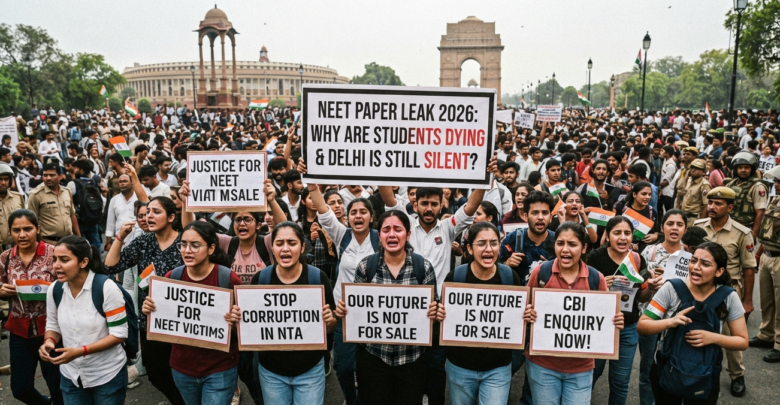
Thousands of students, many of them teenagers who had never attended a protest before, set out from Jantar Mantar toward Parliament under the banner Chalo Sansad. Delhi Police baton-charged the crowd and fired tear gas shells to hold the line; the CJP additionally alleged that pellet guns, officially classified as non-lethal were fired at protesters from close range. By evening, more than 118 police personnel had reported injuries, five FIRs had been filed, and hospital sources told The Indian Express that over 100 people, including students and officers, had been rushed to Ram Manohar Lohia Hospital’s emergency ward, with four protesters in the ICU.
Eyewitnesses described chaos that didn’t discriminate between the violent and the peaceful. One protester told Newslaundry he was struck on the head while standing still, and struck again when he asked the officer to stop. Some personnel were seen wielding lathis without name badges. Internet services around Parliament were suspended as a precaution. Leader of the Opposition Rahul Gandhi called the police response “disgusting”; Samajwadi Party MP Dimple Yadav walked from Parliament to Jantar Mantar in a show of solidarity.
By nightfall, police had cleared the site. By the time most of Delhi was asleep, the students were back — a new stage assembled, the sit-in resumed, as if the crackdown had cost them nothing but a few hours.
Has Education Minister Dharmendra Pradhan Resigned? What Is the Government Saying?
No — and that absence has become its own headline. Union Health Minister JP Nadda met a CJP delegation this week to hear their demands, but Pradhan, the minister protesters actually want to see, has neither met them nor signalled any intention of stepping down. Congress leader Supriya Shrinate has publicly asked why a minister with no direct charge of education was sent to the table instead of Pradhan himself. A CJP spokesperson who attended the Nadda meeting told Hindustan Times the talks had produced nothing — “no response has come from them,” he said and warned the movement would not return to the negotiating table the same way next time.
A pending public interest litigation before the Delhi High Court has separately accused police of subjecting protesters to continuous surveillance and photography, calling it an “atmosphere of intimidation” that infringes on the right to peaceful assembly.
Haven’t We Seen This Before? The 2024 NEET Precedent
This is not India’s first NEET reckoning. The 2024 paper leak controversy produced its own wave of protests, a CBI probe, and a Supreme Court hearing — and ended without any structural change to how the NTA is run or held accountable. Two years later, a new generation of students is fighting the same fight, at a far steeper human cost.
What Happens Next
The coming days will test whether this movement forces something the 2024 protests never achieved — a transparent, accountable NTA, real mental-health infrastructure for exam aspirants, and a government willing to sit across the table from the students it serves. Or whether, like last time, it quietly runs out of road.
For now, the sit-in continues at Jantar Mantar. The government’s silence remains its only official word.
FAQs-
How many students have died by suicide because of the NEET-UG 2026 paper leak? Reports vary by source: Hindustan Times has confirmed at least 11 deaths, Outlook India has independently tracked 13, and advocacy groups following the crisis have cited figures as high as 17, in the roughly six weeks between the exam’s cancellation and the re-test.
Why was NEET-UG 2026 cancelled? The National Testing Agency cancelled the May 3, 2026 results after allegations of a leaked question paper prompted a probe by Rajasthan’s Special Operations Group, which was later escalated further amid nationwide protests.
What is the Cockroach Janta Party (CJP)? The CJP is the political campaign leading the Jantar Mantar protest movement, demanding Education Minister Dharmendra Pradhan’s resignation, an overhaul of the NTA, and compensation for the families of students who died by suicide following the NEET crisis.
What happened during the July 20 “Chalo Sansad” march? Delhi Police used tear gas and lathi charges to stop thousands of students marching from Jantar Mantar to Parliament, alongside CJP allegations of pellet gun use. Over 118 police personnel and more than 100 protesters were reported injured, with four protesters admitted to intensive care.
Has Dharmendra Pradhan resigned as Education Minister? No. As of July 21, 2026, Pradhan remains in office and has not met the protesting students directly, despite mounting demands from opposition leaders and the CJP.