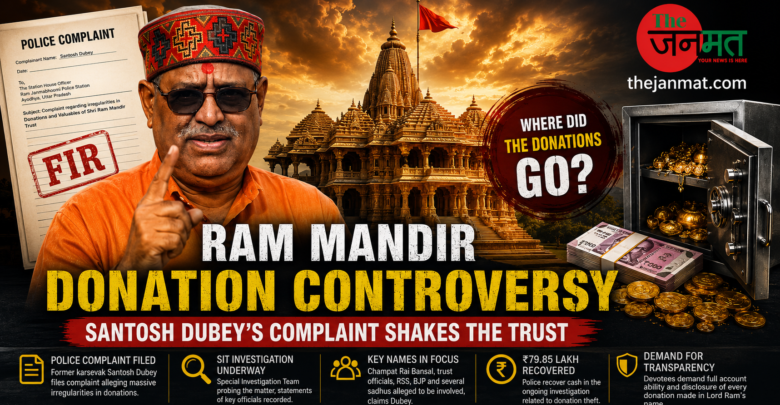
The Ram Mandir in Ayodhya, one of the most significant religious and cultural projects in modern India, has become the centre of a major controversy following allegations regarding the management of donations and offerings received from devotees. The issue gained attention after former Ram Janmabhoomi movement activist and kar sevak Santosh Dubey raised questions about the accounting and handling of valuables offered during the movement and after the construction of the temple.
Santosh Dubey, who has been associated with the Ram Janmabhoomi movement since its early days, filed a formal complaint demanding an investigation into alleged irregularities related to donations, including cash, gold, silver ornaments, precious items and other offerings made by devotees. He argued that every contribution made by people in the name of Lord Ram carries deep emotional and religious value and should be transparently accounted for.
The complaint triggered a wider discussion across social and political circles, with questions being raised about the functioning of religious trusts, management systems, and the responsibility of individuals handling large-scale public donations.
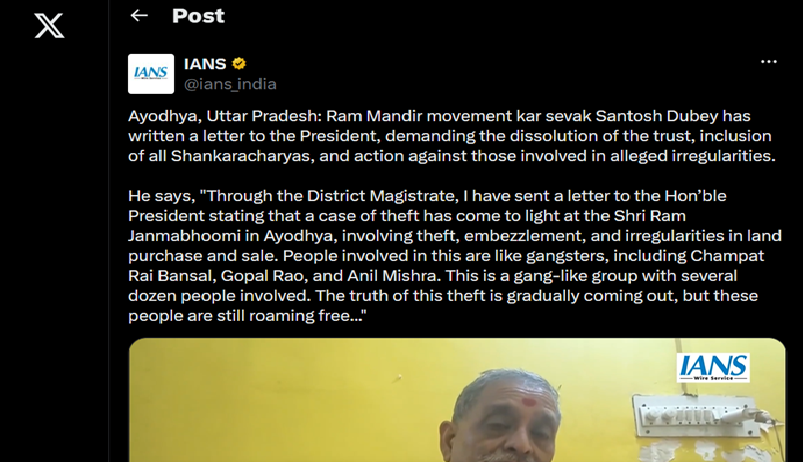
Santosh Dubey’s Complaint and Allegations
According to reports, Santosh Dubey alleged that certain valuables and donations connected with the Ram Janmabhoomi movement and temple-related offerings were not properly accounted for. He raised concerns about gold, silver items, special bricks and other symbolic offerings that devotees had contributed with faith during the movement.
Dubey claimed that thousands of devotees had donated valuable items over decades with the belief that they would become part of the historic Ram Mandir construction journey. He demanded that records of these donations, inventories, financial documents, and related evidence should be examined.
The complaint also named individuals associated with the Shri Ram Janmabhoomi Teerth Kshetra Trust and sought action against those responsible if any wrongdoing was established.
Dubey’s central argument has been that the issue is not only about money or valuables but about the trust of millions of devotees who contributed emotionally and financially towards the Ram Mandir movement.
Investigation Begins and Controversy Expands
Following complaints and public attention, authorities initiated an inquiry into the allegations. The matter reportedly involved questioning people associated with donation handling and reviewing relevant records. The investigation brought additional focus on the processes followed for receiving donations, maintaining records, storing valuables, and transferring offerings. Reports indicated that authorities examined the roles of various people connected with donation management. The inquiry aimed to determine whether there were any procedural lapses, negligence, or criminal activity. The controversy gained further momentum after reports emerged about alleged theft-related investigations and recovery of money connected with the case. Authorities continued examining evidence and statements from individuals involved.
Questions Around Trust Administration
The Shri Ram Janmabhoomi Teerth Kshetra Trust was formed to oversee the construction and management of the Ram Mandir project. Since its formation, the trust has handled a large number of donations from devotees across India and abroad. Due to the scale and emotional importance of the project, transparency in financial and administrative matters has always been a major public concern.
Supporters of an inquiry have argued that religious institutions receiving public donations must maintain complete transparency through proper accounting systems, audits, and disclosures. At the same time, officials connected with the trust have maintained that systems exist for managing donations and that facts should emerge through proper investigation rather than speculation.
Santosh Dubey’s Media Statements and Wider Debate
In recent media interactions, Santosh Dubey has continued to express concerns and demanded deeper investigation. During discussions and media appearances, he questioned whether accountability should only focus on a few individuals or whether the wider network involved in managing the temple affairs should also be examined.
His statements have brought several names and organisations into public discussion, including senior figures connected with the temple movement. Some political voices and commentators have also expanded the debate by raising questions involving organisations such as RSS and political groups connected with the broader Ram Janmabhoomi movement. However, these remain allegations and political discussions unless established through official investigation and evidence. The controversy has therefore moved beyond a single complaint and has become a larger debate about transparency, responsibility, and public trust.
Role of Devotees and Emotional Connection
The Ram Mandir movement has a unique place in modern Indian history. Millions of people participated in different ways through activism, donations, prayers, and social involvement. For many devotees, contributions made during the movement were not simply financial transactions but expressions of faith.
This emotional connection is one reason why the allegations have attracted significant attention. Many devotees believe that every offering connected with the temple should be preserved, documented, and handled with the highest level of responsibility. The demand for transparency is not limited to one individual or group; it reflects a broader expectation that institutions of religious importance should maintain strong governance standards.
Political Angle and Public Reactions
The controversy has also entered the political space. Leaders from different sides have issued statements, with some demanding stronger investigation and accountability. Critics have questioned whether powerful organisations and influential individuals associated with the movement should also answer public concerns. Supporters of the trust have argued that the matter should not become a political issue and that the investigation process should be allowed to establish the facts. The involvement of political parties, religious groups, and social organisations has increased public attention around the case.
Need for Transparency in Religious Institutions
The controversy highlights a broader issue regarding the management of large religious institutions.
Across the world, temples, mosques, churches, and other religious organisations that receive public donations are expected to maintain transparency because they operate on public faith.
Experts often suggest that strong accounting practices, independent audits, digital records, and public reporting mechanisms can help maintain confidence.
For a project as significant as the Ram Mandir, maintaining public trust is especially important.
What Happens Next?
The final outcome of the controversy will depend on the findings of the investigation, evidence collected, and legal proceedings. If any wrongdoing is proven, appropriate action would be expected against those responsible. If allegations are found to be unsupported, the investigation would help clarify doubts and restore confidence.
For now, the issue remains under examination. The Ram Mandir continues to represent a powerful symbol for millions of devotees. The controversy surrounding donations has created an important conversation about faith, responsibility, and transparency. The expectation from many citizens is clear, every contribution made in the name of Lord Ram should be respected, documented, and protected with complete accountability.